SD-WAN for Multi-Location Businesses: What It Is and Why You Probably Need It
If you’re running a business with two or more locations in Southern California — whether that’s a handful of dental offices across Orange County, a chain of auto dealerships in the Inland Empire, or a group of treatment centers throughout Riverside County — you’ve probably dealt with the headache of managing internet and network connectivity across multiple sites. Each location has its own internet connection, its own set of problems, and its own bill. And when something breaks, good luck figuring out which vendor to call.
That’s the problem SD-WAN was built to solve. And no, you don’t need to be a tech company or have an IT department to benefit from it.
What SD-WAN Actually Is (Without the Buzzwords)
SD-WAN stands for Software-Defined Wide Area Network. In plain English, it’s a smarter way to connect your business locations to each other and to the internet.
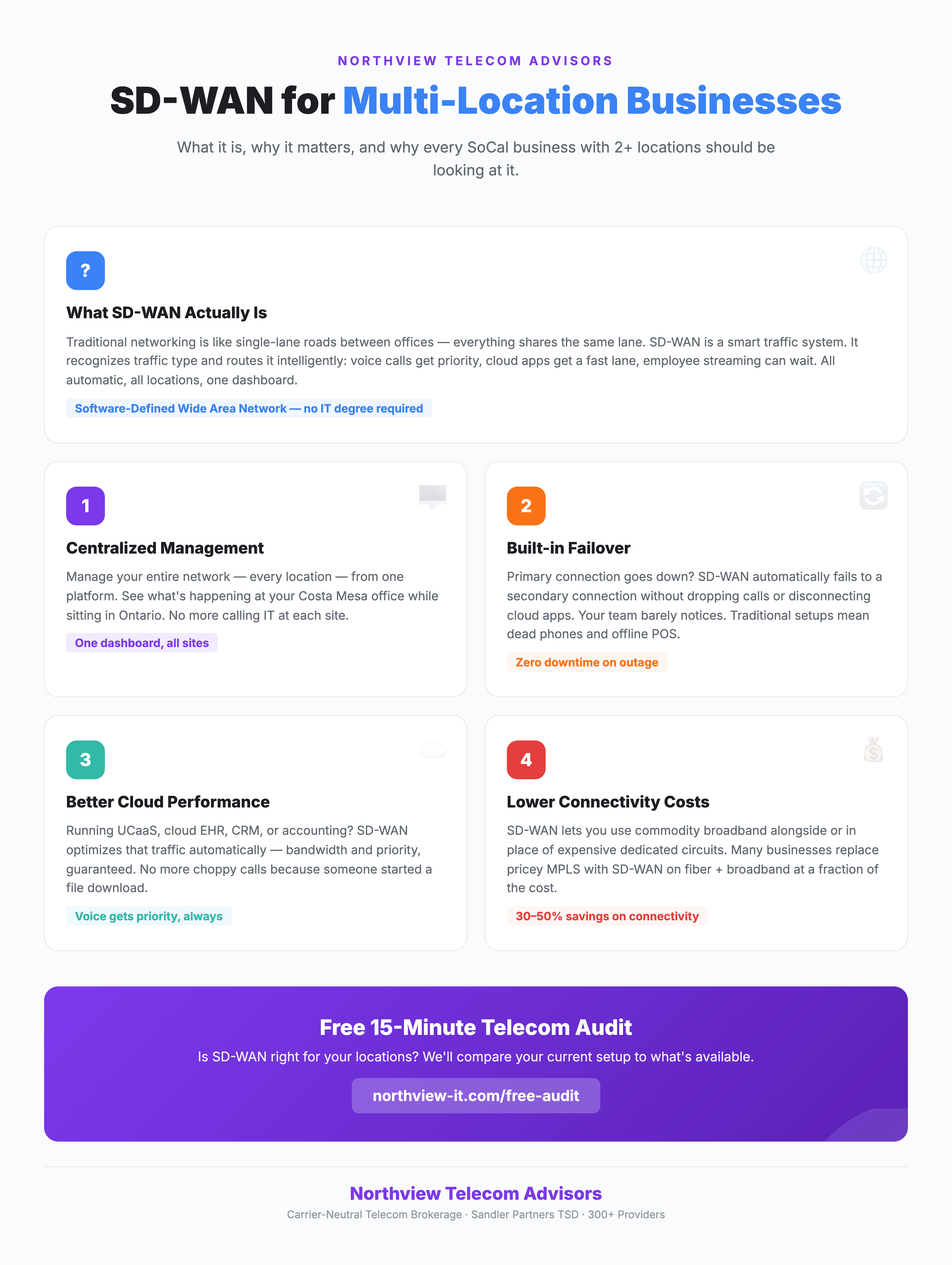
Think of it this way: traditional networking between offices is like having a single-lane road between each location. Everything — your phone calls, your cloud apps, your point-of-sale systems, your video surveillance — all shares the same lane. If one thing hogs the bandwidth, everything else slows down.
SD-WAN is like replacing those single-lane roads with a smart traffic system. It recognizes what type of traffic is flowing and routes it intelligently. Your voice calls get priority. Your cloud-based electronic health records get a fast lane. Your employees streaming training video? That can wait. It handles all of this automatically, across every location, from a single dashboard.
Why Multi-Location Businesses in SoCal Are Moving to SD-WAN
1. Centralized management across all sites. With SD-WAN, you manage your entire network — every location — from one platform. You can see what’s happening at your Costa Mesa office while you’re sitting in your Ontario location. No more calling IT at each site to troubleshoot individual problems.
2. Built-in failover. When your primary internet connection goes down (and in Southern California, it will — between aging infrastructure in some areas and construction disruptions in growing markets like the IE), SD-WAN automatically fails over to a secondary connection without dropping your calls or disconnecting your cloud apps. Your team barely notices. With traditional setups, an outage means your phones go dead and your POS system goes offline.
3. Better performance for cloud apps. If you’re running any cloud-based tools — and nearly every business is at this point — SD-WAN optimizes that traffic automatically. Whether it’s your UCaaS phone system, your cloud-based EHR, your CRM, or your accounting platform, SD-WAN ensures that traffic gets the bandwidth and priority it needs. No more choppy phone calls because someone at the Brea office started a large file download.
4. Lower overall connectivity costs. This is the one that gets people’s attention. SD-WAN lets you use commodity broadband connections (like cable or fixed wireless) alongside or in place of expensive dedicated circuits. Many multi-location businesses are paying for pricey MPLS circuits at each site when they could get better performance from SD-WAN running on a combination of fiber and broadband at a fraction of the cost. We’re talking 30-50% savings on connectivity in many cases.
5. Easier expansion. Opening a new location? With SD-WAN, you can ship a pre-configured appliance to the new site, plug it in, and it’s online and connected to your entire network within hours — not weeks. No on-site IT visit required. For growing franchises and multi-location operators, this is a game-changer.
Is SD-WAN Right for Your Business?
Not every two-location business needs SD-WAN. If you have two offices that barely interact and each runs independently, you might be fine with standard business internet at each site.
But if any of these sound familiar, it’s worth a conversation:
– You have three or more locations sharing data or applications
– You’ve experienced downtime at one location that hurt productivity or revenue
– You’re paying for expensive MPLS or private circuits and suspect there’s a better option
– You’re planning to add locations in the next 12 months
– You rely heavily on cloud-based voice (UCaaS) or cloud-based line-of-business apps
– You need consistent security and compliance (HIPAA, PCI, CMMC) across all sites
The Carrier-Neutral Advantage
Here’s something most people don’t realize: SD-WAN is not a carrier-specific product. You don’t have to go all-in with one provider. In fact, the best SD-WAN deployments often mix carriers — maybe AT&T fiber at your primary site, Spectrum Business at another, and a fixed wireless backup at a third. SD-WAN ties it all together.
That’s where a carrier-neutral approach matters. We look at what’s actually available at each of your locations — which carriers serve which buildings, what speeds are realistic, what the pricing looks like — and design a solution that makes sense for your specific footprint. Not what a single carrier wants to sell you.
What to Do Next
If you’re managing multiple business locations in Southern California and you’re tired of the connectivity headaches, we should talk. We’ll review your current setup across every site, benchmark your options from 50+ carriers, and give you a straightforward recommendation — including whether SD-WAN makes sense for your situation.
The review is free. It takes about 20 minutes per location. And if the answer is that you’re already well-served, we’ll tell you that too.
Schedule your free multi-location connectivity review →
Want expert guidance on your business telecom?
We offer a free, no-obligation telecom audit for Southern California businesses.
Want expert guidance on your business telecom?
We offer a free, no-obligation telecom audit for Southern California businesses.
Book a Free Audit →