How to Read Your Business Telecom Bill (and What to Look For)
Most business owners do one thing with their telecom bill — approve it for payment. Month after month, the same amount gets paid without anyone looking closely at what is actually being charged.
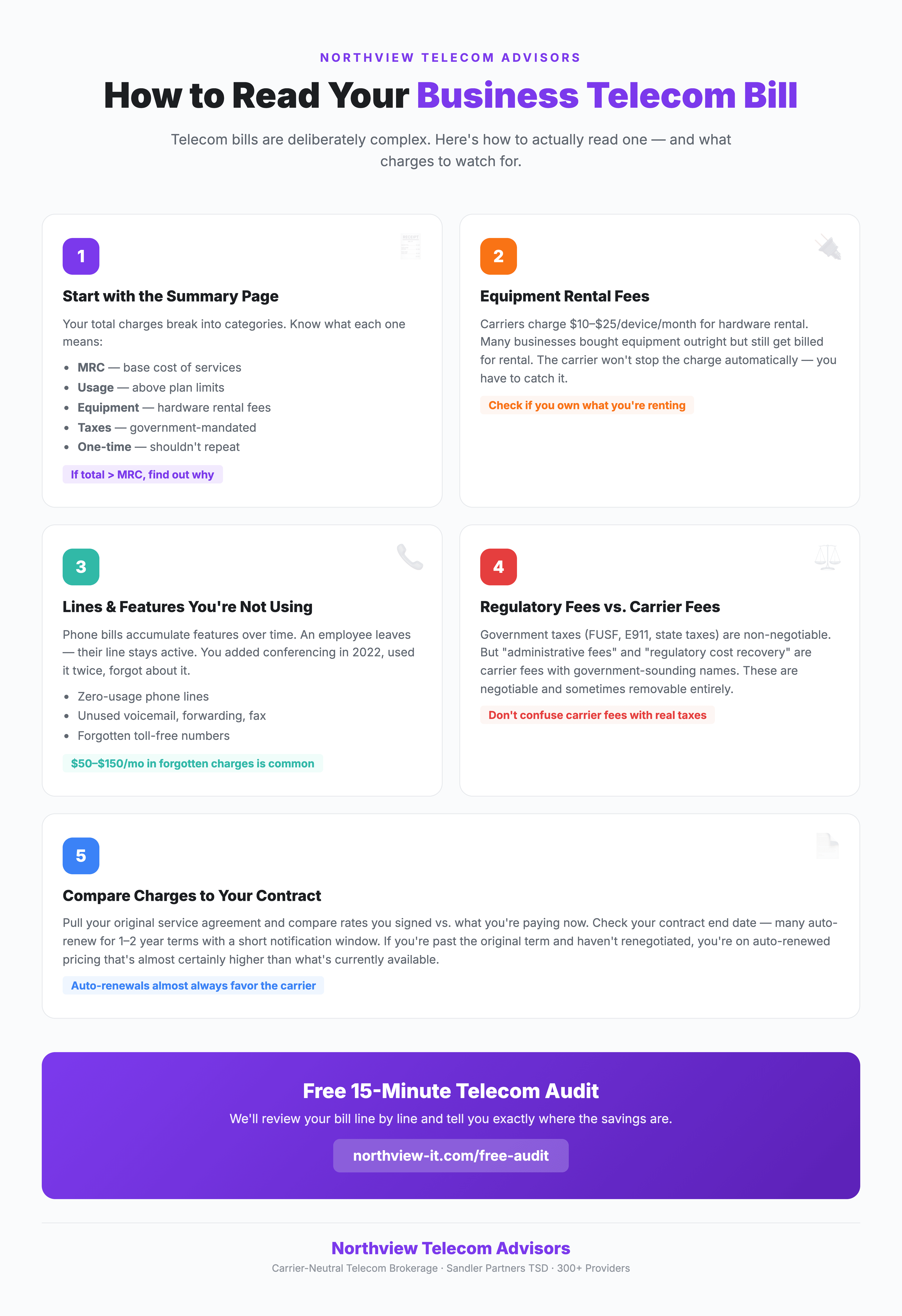
That is not negligence. Telecom bills are deliberately complex. Carriers have no financial incentive to make them easy to understand, and most of the line items have names that do not mean anything to a normal person.
Here is how to actually read one — and what to look for.
Start with the Summary Page
Every business telecom bill has a summary page that shows your total charges broken into categories. The categories you are looking for:
- Monthly recurring charges (MRC) — the base cost of your services
- Usage charges — anything above your plan limits
- Equipment charges — rental or lease fees for hardware
- Taxes and regulatory fees — government-mandated, not negotiable
- One-time charges — installation, changes, or fees that should not repeat
If your total bill is significantly higher than your base MRC, you need to understand why before you approve payment.
Equipment Rental Fees
This is one of the most common sources of unnecessary charges we find during audits. Carriers charge monthly rental fees for modems, routers, and other hardware — typically $10–$25 per device per month.
The problem: many businesses purchased their equipment outright months or years ago and are still being billed for rental. The carrier does not automatically stop the charge when you buy the equipment. You have to catch it and dispute it.
Check your bill for any line item that says equipment rental, modem lease, or similar. Then check whether you actually own that equipment. If you do, call your carrier and request a credit.
Lines and Features You are Not Using
Business phone bills in particular accumulate features and lines over time. An employee leaves, their line stays active. You added a conference calling feature in 2022, used it twice, and forgot about it.
Look for:
- Phone lines with zero or near-zero usage
- Features listed individually — voicemail, call forwarding, conferencing, auto-attendant — and whether you are actually using them
- Toll-free numbers you no longer need
- Fax lines (yes, still common, often completely unused)
Each of these is a small charge, but they add up. Businesses I audit routinely have $50–$150/month in features they forgot they were paying for.
Regulatory and Surcharge Line Items
These are real but worth understanding. Common ones:
- Federal Universal Service Fund (FUSF) — a percentage of your bill, mandated by the FCC
- State and local taxes — vary by jurisdiction
- E911 surcharge — supports emergency services
- Administrative fees — these are carrier-generated, not government-mandated, and are negotiable
The key distinction: government taxes are non-negotiable. Carrier administrative fees and regulatory cost recovery fees are not government fees — they are carrier fees with government-sounding names. These are negotiable and sometimes removable entirely.
Compare Current Charges to Your Contract
Pull out your original service agreement and compare the rates you signed to what you are currently being charged. Carriers are allowed to raise certain fees over a contract term, but not all of them. If your base internet rate has gone up mid-contract, that worth a call.
Also check your contract end date. Many contracts auto-renew for 1–2 year terms with a short notification window. If you are past the original term and have not renegotiated, you may be on auto-renewed pricing that is no longer competitive.
What to Do If You Find Something
Call your carrier business support line — not the general consumer line. Ask specifically about each charge you want explained. If you find equipment rental on owned equipment or features you did not authorize, request a credit going back as far as they will allow. Most carriers will credit 3–6 months without significant pushback.
If reading your bill raises more questions than it answers, a 15-minute telecom audit will give you a clear picture of what you are paying, what you should be paying, and what can be eliminated.
Want expert guidance on your business telecom?
We offer a free, no-obligation telecom audit for Southern California businesses.
Book a Free Audit →